Saturday, June 14, 2014

Color correction and sharpness

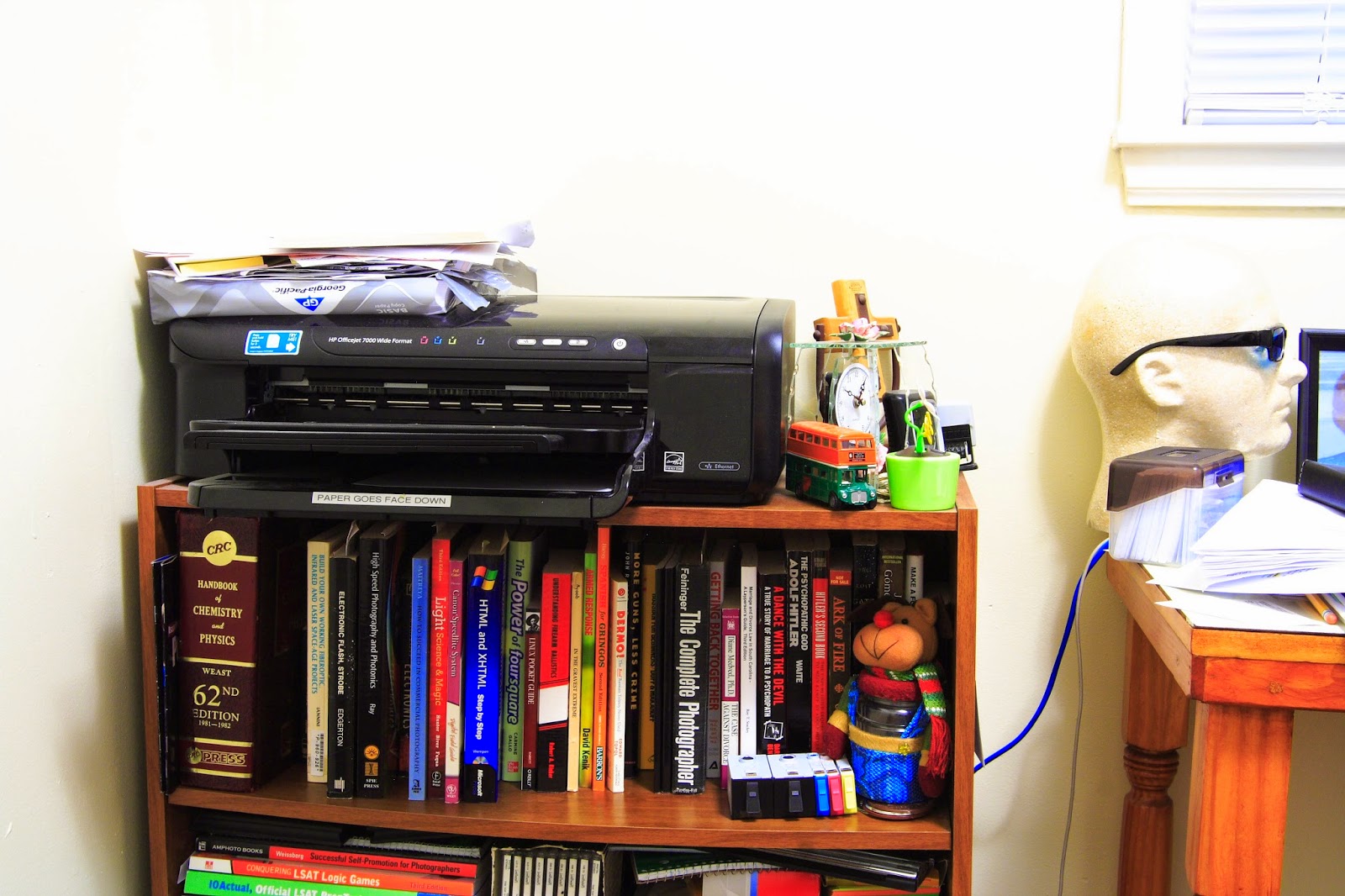
Today there was a rather ridiculous assertion online made that 8 megapixel images look "fuzzy". Thus, here are two versions of the same image taken a few days ago. The subject isn't anything particularly stunning nor is the equipment. The camera is a very elderly Canon XT from 2006 coupled with an older Tamron 17-35. Even the printer in the picture isn't made any more, replaced by a wiFi model.
If the option to zoom in to 1:1 is taken, it's possible to see that there is no fuzz at all on the image. It's a pretty good image that would print to around 8 x 12 at 300dpi or at a more realistic 150dpi to 16 x 24. It's way bigger than most need to print and way bigger than is needed for online usage. It's largely why the camera has not been upgraded to one of the new 36 megapixel units. Needless to say, this image was straight from camera.

There is indeed a color cast from the compact fluorescent lamp in the office. In the following image, the image has been corrected for color cast, sharpened a little, the contrast has been tweaked. The saturation remains largely the same but the exposure has been tweaked by 2/3 of a stop. The result is quite pleasing and all the more so since it was all done with Canon's File Explorer.
Yes, the shelf is bowing under the weight of the books on the shelf - it is not a function of the lens. At 24mm there should be no distortion at all on a 17-35. The exposure was 10 seconds at f16, 100ISO.

Checking the image closely, it's possible to see what might look like halation on the printer but what that is in actual fact is dust. There's plenty dust in that office. The following is a crop from the center of the image.
Even though this is not quite at 100%, it's possible to see just how sharp the image is. The idea that 8 megapixel images are at all fuzzy is completely disproven. The color correction, sharpness etc were all adjusted slightly but not majorly. The top image was a JPEG straight from the camera. The second and third are a RAW image, created by the camera and then converted during post processing to JPEG.

Friday, June 13, 2014

Why I dumped LinkedIn

Ages ago, I joined LinkedIn. I really can't remember why I joined or even when. Yesterday evening I had just updated my profile to make it livelier and suddenly found my account had been locked. Well, that was very strange because those of you that know me will realise that everything posted online is pretty mild - especially given that LinkedIn was the only account that I published under my own name. I'm not sure what the problem is but that doesn't really bother me to be quite honest. The whole thing is that though I'd put a lot of work into LinkedIn yesterday to try to spruce it up, I really, truly don't care about LinkedIn. It never generated traffic for my blog. It never generated traffic to Facebook just as Facebook never generated traffic to my blog. It never even generated interest in what I can do for people.
When my LinkedIn account was blocked, I asked what the problem was and was pretty much told "somebody complained and we're not going to say what they complained about or why but you're blocked so nya-nya-nya". There are really only two things to consider there - either there's a troublemaker or there's been an error on LinkedIn's part. If it was a troublemaker, LinkedIn is welcome to them. If it's an error then it'll likely happen again and it'll happen to somebody else because I'm not going to return.

As I told a friend, mentioning LinkedIn: I was commenting on articles and getting some feedback. Lots of people seemed to like my anti careerbuilder article. I don't think that LinkedIn has been at all worthwhile though. Like all of this online stuff, it eats time and promises a lot but produces nothing And that is the soundest condemnation anybody can ever give anything online! I never had any contacts about work out of LinkedIn - there were many agencies that promised to look at my resume but never did. It was in terms of gaining or changing employment, utterly valueless.

Being without LinkedIn is more of a relief than anything else. It's another one of the interminable pieces of online dross gone that I don't have to keep updated or worry about. I'm not the only person to think little of LinkedIn either.
Linkedin has endorsements and I found I was getting endorsed for really strange things that I'd never handled. I never put anything on my profile about accounts receivable yet had 15 endorsements for it. I never put "telephone skills" on my profile yet had 30 endorsements for it - all from people I don't even know and have never even communicated with - including some from Russia.

Over the past couple of years I have systematically removed anything with my real name on it from the internet. I have a strong suspicion that posting under a pseudonym is much to be preferred. I did meet a recruiter that used to look up applicants online before interviewing them. Having done a quick check just now, I am relieved to find that there is nothing visible for at least the last five years other than some out of date telephone numbers.

One of the craziest things is that people on LinkedIn write recommendations for each other. Out of sheer curiosity I had somebody I didn't know from Adam to do an recommendation for me. They got my gender completely wrong and I wrote them a recommendation too. With that level of fakery on LinkedIn, it's well worth doing without it. To cap all that off, I still get spam from LinkedIn groups and when I try to unsubscribe, it tells me I am not authorised. LinkedIn has become spam.

The other crazy thing about LinkedIn was the way people wanted to become my friend. Well, wasn't that special? I allowed about 850 people to become my "friend" on LinkedIn. After they became my "friend" they just slipped into obscurity and I never heard a word from them. I don't even believe I knew many of my new "friends" in real life. This is supposed to be a "business" forum. Nothing there sounds remotely businesslike - especially if there was somebody going round looking for reasons to be insulted or slighted or whatever.

So to recap: On LinkedIn I had
  • People wanting to be my friend that I'd never met nor heard of.
  • The people that became "friends" never interacted with me.
  • Fake references witten for me at the drop of a hat.
  • Fake endorsements by people I didn't know and for skills I didn't even possess including pottery, basket weaving and taxidermy.
  • Anonymous people going behind my back to complain to LinkedIn instead of sending me a message directly saying that they had an issue with whatever issue they dreamed up.
  • Inane articles about business that had holes a mile wide.
  • Inane articles about business that were really infomercials or sales gimmicks.
Perhaps the thing that made me laugh the most was the following (taken from an email interchange with LinkedIn support)
As a courtesy, I've gone ahead and temporarily removed the restriction from your account so you can make changes. Please know that if no action is taken by you to update your name fields, your account may be subject to future restrictions. Here's a link that will let you check and update your name fields:
Clearly using my real name wasn't a smart thing to do. I should have used a pseudonym. Apparently my real name is no longer good enough. Goodbye LinkedIn, you won't be missed.

Thursday, June 12, 2014

Gain more blog readers and more blog comments

More blog readers and more blog comments mean more people are clicking on adverts and increasing income from the blog. It makes sense. Thus most people will list their blogs with all of the blogs listings services that are plastered all over the internet. Some even pay to popularise their blogs. This blog even had several popularisation widgets attached.

Did the blog popularisation widgets do anything? Absolutely not. They do increase apparent visits to the blog but those "visits" are just phantom hits. There's nobody actually viewing the blog. As an example, somebody listed one of the pages on a Romanian website. Within two days, that page had racked up 1,500 viewings. Now if those had been genuine visitors then at least 3% would have clicked on an adsense advert. That would mean 45 clicks on adsense adverts. Instead, try zero clicks.

Getting visitors for a blog is a matter of constant promotion. Some people will return. This blog gets about 24% return visitors. Of course, what screwed the figures up for a long time was a cyberstalker that used to click pages before and after work. All those hits came from a roadrunner user in the Irmo area. There'd be between 180 and 200 a month. Heaven knows what that was all about but those seemed to drop off around mid February and have not returned.

Promotion consists of getting as many back links as possible without having to give away forward links. That means, getting people to link into the blog rather than anything else. Content is another issue. The blog has to have content people want to read. In bewilderment at the lack of interaction on this blog, the problem was put forward for free marketing advice since a link had been placed on LinkedIn. That link led here. It transpired that there's absolutely nothing wrong. The articles are of high quality. There could be some links to other sites (which are commencing today) and the layout could have been better. The layout has been changed. The old layout looked very newspapery and was quite pleasing to the eye but the number of advertisements shown plummeted as did income. Now the traditional templates are back in use and while less visually stunning, are easier to navigate.

The goal of any blog is to gain engaged readers. This blog is failing spectacularly at that. In fact, both this blog and the other blog are failing. Controversial posts and posts with a perceived sexual edge seem to be popular. The rest just don't get many views at all. Posting links to pages in discussions that people are engaged in online does get views - sometimes hundreds of views. Very few of those views seem to result in advertising clicks. Clearly the target audience has not been reached.

Microblogging, using Twitter has the same issue, namely lack of worthwhile viewers. Ages ago, a Twitter follower adder was used and across several accounts, 14,000 followers were amassed. None of those "followers" was at all responsive. Then auto-retweeters and auto-tweeters were added. There was absolutely no engagement. Then a new Twitter account was started. There was no auto follower adder used. Largely people known were added and yet - very little engagement. It was only when politically controversial tweets were added that engagement levels rose slightly. Whether that will lift blog engagement levels remains to be seen.

The general look of things is pretty dismal. The blog is interesting. The posts are of good quality - and that's according to independent reviewers. Visitors are just not arriving. Perhaps photography has had its day? It could well be that since 90% of people use smartphones for their photography that photography has become so commonplace that few take any real interest in it. This would be a bit like calligraphy - people try it and play with it then put it to one side and carry on as normal.

So, blog readers and more blog comments? Most of the tricks suggested have been tried and found not to work with these specific blogs. Perhaps they will work with others? If anybody has any suggestions, please feel free to comment below.