Saturday, February 22, 2014

Documentary photography of the closure of a bookstore

For reasons I won't get into I ended up working at a bookstore. I won't say much about the job other than I was given an ever increasing amount of hours and then after working for most of a year officially part time (but with full time hours), I was promoted to Head Cashier. A couple of months later, it was announced the store would close. Thus I applied for a few jobs and ended up with one so my final day was today though the store (which closed to the public last week) is still manned while people are packing display units and product. That will probably continue for the next month or so.

While I didn't think to get photos of the store from the same position during the process, I have a medley of photos taken during the process.
This was the cafe, where I used to enjoy my lunch every day when I worked at the bookstore. It was more expensive than a packed lunch but not so much so as an employee. Numbers of times I remember having to head behind the counter to sort out a problem with a register during my lunchbreak. Happy days.
Although I was the Head Cashier, my task every Thursday morning was to arrive at 7am to start shelving magazines. This was driven mostly by the fact that I was the only bookseller willing to turn up at such an ungodly hour and was meticulous enough about the task. Everybody including myself hated magazine shelving. My philosophy was that since I was being paid to do it, I'd do it to the best of my ability in the two hours allowed before the store opened. After that I went back to my Head Cashier role.
 This was my domain. I ran this office better than any previous Head Cashier. There were no errors in the accounting on my watch. Perhaps the most heartsinking moment was when I dropped two cash trays full of cash on the floor and had to collect all the cash - including the coins that had fallen into the trashcan (which by the way was full of soggy tissues and an empty coke can) before re-counting and putting the right change back in each cash tray. My task every opening morning aside from doing all the record keeping and documentation was to open the safe and count the money. My task every closing evening was to do the record keeping and count all the money. Needless to say during the last week of working there before the store closed, I made sure the money was right but skipped a lot of the documentation which I saw being tossed in the garbage after the store closed for good.
This is a photo before the closing news had broken and before the closing sales had started. I must admit that the New York management had the sales scheduled perfectly. Almost all of the bargain stuff had sold and a lot of the non-bargain by the time the store closed. When I left to work elsewhere there was about a day's worth of stock left to pack to ship off to warehouses etc. 

The $20,000,000 question I am always asked is why the store closed. What I was told by the company was that it was a lease issue and that the landlord had not renewed the lease. The landlord's representative told me (when he was down at the store) that the company had refused various different offers. My personal opinion is that over the years I worked there, customer traffic had declined. Combining declining customers, raising rent and lower profits probably meant that the smart thing was to close the store. The death of bookstores really came about when e-readers were introduced. Add to that, the model of a bookstore has changed. Big used to be beautiful. Now it's more often the smaller bookstore with a cafe, a well-chosen selection of popular current fiction, based upon the preferences of the local customer base and a selection of more eclectic works that survives and prospers. Needless to say, a cafe is a must. People like to sit and read. People like to eat and drink while they read too.
I tried most of the food in the cafe. I can't say that I was a great fan of it. As one of the employees stated, it was sustenance but it wasn't a place to go if you wanted to eat. I couldn't really eat the stuff with dairy products in it due to a slight lactose intolerance. The cookies tended to be a shade too sweet but the savories were quite pleasant. None of it was what I would call diet friendly.
After a week or two of the closing sale starting, all the children's toys and games had vanished totally. Normally they were a product that just didn't seem to sell - like a great many of the products. It was amazing to see people coming up with hand carts full of products that might sell at the rate of one or two a week. 
Things shifted slowly when the discounts were at 30% then sales picked up when they reached 40% but didn't get much faster when they reached 50%. Even though there was a closing sale, the shop just didn't feel as busy as it had in previous years. I just had the feeling that there were fewer people buying things and that they were buying cheaper things. I wonder just how much effect the e-reader has had on this.
Behind the scenes. This is the part the public never sees. This is the staff room where meals are eaten, meetings are held and where I have clearly left my coffee (in the white cup) on the table. In the corner was the food and drink machine that pedaled products my friend Linda called "pure poison". I didn't think they were that bad. The problem some people seemed to have was with the machine eating money and not producing a product or producing an empty can etc. I never had an issue.
Toward the end, there were many empty fixtures. Product moved around and the empty fixtures quietly shuffled out of sight of most shoppers to give the impression of full shelves.
The shelves look full but look closely at the bottom shelf and it's empty. The very top shelf has been removed to make it look as though there's plenty stock.
The effect is much more visible here, on the local history bay. Notice how the top and bottom shelves are empty. My personal opinion is the bottom shelves are just too low for most people and the top two rows are ridiculous. Imagine somebody of 5'6" or less trying to reach up there! I could barely reach the top and I'm 6' tall.
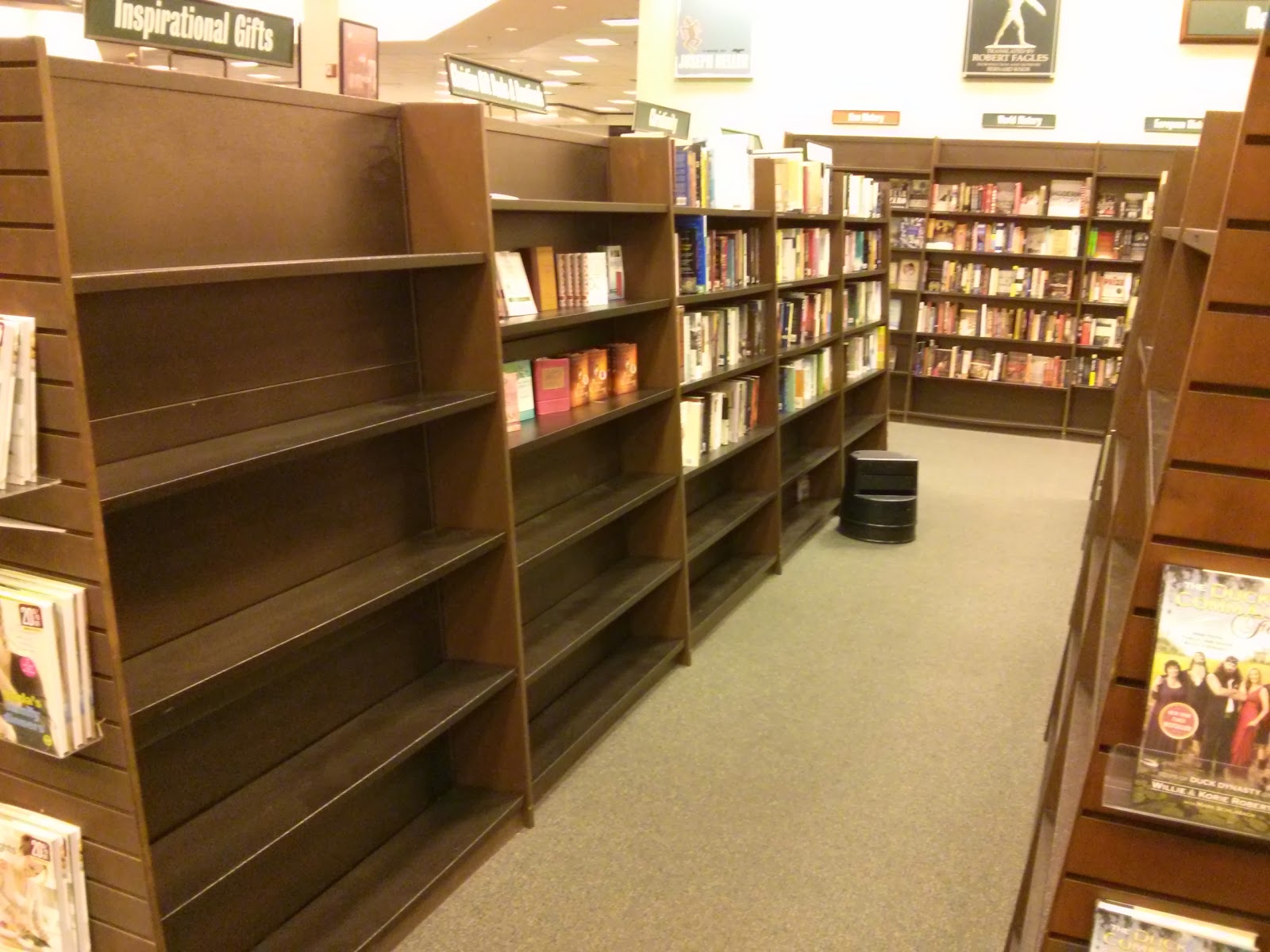
As the sale progressed, normally priced stock was not replenished and several entire bays became empty. It became less important to make the shop look full and more important to make it look tidy. Needless to say, with fewer products on sale, the tidying that used to take 2 hours and started an hour before the store closed became ever quicker. Occasionally some dust would be removed but this just stopped happening like a great number of things. 
The stock room suddenly acquired a couple of palates of flat-pack cardboard boxes and huge quantities of bubble-wrap, ready for the massive operation to box the remaining products ready to ship off back to the publishers and distribution centers. Some products labeled as "strip", the publishers didn't want back and just requested that the covers be sent to them. That was so that they knew the book couldn't be sold on the black market. The rest of the book was then dropped into the recycling container outside. I believe that container was filled several times.
Back in my domain, I had to count the cash. I hated handling cash. It's a very dirty thing to handle. Who knows whether people have picked their noses and handled the cash, washed their hands after visiting the toilet before handling cash or even dropped it into something nasty before picking it up and using it. A bank manager friend of mine told me that the number one contaminant on money is not excrement. That's number two. Number one was cannabis. In the picture there, you can see probably about $2,000 of money. I don't see how people can get so excited about grubby paper and metal disks. Maybe I'm an oddball. Money has never excited nor interested me.

Toward the very end, it became an issue with people pulling out fixtures and taking them to the cash registers to ask how much we wanted for them. They were not for sale - they were intended for use in other bookstores. Several times I was asked if I wanted any of the minor items such as decorations etc but my answer was always the same. There was nothing in the store that I really, honestly, wanted. If I want a book, I look it up on abebooks.com and buy it off them. Secondhand books are so much cheaper.
The day after the store had closed. The magazine racks in the background were empty. They were the first thing to be emptied, which was a shame. I'd have liked to have sat down and read through some of the magazines. I never had time when I was working there. There were many that looked interesting but working there I never had the time to read them nor the inclination or money to buy them to read them at leisure. To be honest I think magazines are a horrible waste of financial and material resources. They're expensive and once they've been read, they get thrown out and not largely recycled. The internet is a much better resource than most magazines and just as debatable from an accuracy point of view.
Over the week after closure, shelves began to empty. Books were sorted according to publisher and removed from the shelves by publisher to be boxed and sent off to the publisher or to the distribution centers.
Each day the books that came off the shelves got packed into boxes. The boxes were supposed to hold up to 50lbs but it was very hard to judge and impossible to change once they'd gone over as there was just one set of scales supplied and several people packing boxes of books. Quite a few of mine were over 60lbs and one went to 71lbs. That's on the bottom row, 3rd from the right. It was a case of packing the books on a table and carrying the box to the box area. I pitied the poor truck driver who had to load and move all those boxes. He must have been terribly strong or terribly exhausted later.
Little by little, all the shelves were emptied and the carcass of the bookshop was left behind. Meanwhile representatives of other stores within the chain came to remove the fixtures they wanted. It became comical at times. I looked up to the clock in the break-room to see what the time was and it had gone. I checked my watch and found it was wrong - probably due to the solar flares the night before. Thus my timepiece was solely my mobile phone. Similarly, the automatic paper towel dispensers in the toilets had vanished, which we discovered when we wanted them. Then when we wanted to throw away the paper towels we'd located and used, the bins had also gone.
This is my final photograph of the gutted and desolate bookstore. Needless to say I have other photographs but though they might not be the "best" photographs from a nitpicker's point of view, they are documentary photographs. I wish I had photographs of the bookstore before it closed, showing fully laden shelves. 

My time at the bookstore was an education in dealing with the public en masse. During this time I applied myself to the position and won a great number of sales awards. I am not that enthusiastic about sales even though I'm very good at sales.

Thursday, February 20, 2014

The future of lighting

For over 100 years, the incandescent light bulb gave light to the masses; cheap, safe light. It was safer than candles and oil lamps and cheaper to run after wiring and so on had been taken into account. Then along came the compact florescent light which slowly usurped the place held by the incandescent light bulb. Legislation was enacted banning the production and use of incandescent bulbs under the guise of environmental friendliness.

Some truths about CFL bulbs are uncomfortable - they contain mercury which the original incandescent bulbs did not. Worse than that, they contain mercury vapor - in fact their original name was the mercury vapor lamp. Suddenly they don't sound so friendly. All the older bulbs could be 100% recycled. The CFL bulbs need to be disposed of in special facilities.

Recently, along came a new kind of light - the white LED. They're still in the early stages but they are available for use in desk lamps and more. The best thing - no mercury and they have a life of about ten years compared to the year of an incandescent bulb or the three years of a mercury vapor bulb. Even better than that, while a 100 watt incandescent bulb will produce around 16 lumens per watt or 1600 lumens, a CFL will produce around 60 lumens per watt. Thus, to get the same lumens as a 100 watt incandescent bulb we only need a 26 watt CFL. People often complain CFLs are dim and they are because 13 watt is the most common variety and that's half the power of a 100 watt incandescent bulb.

Forward a little and along came the breakthrough everybody was waiting for. For years, LEDs had been available solely in red, yellow or green. Suddenly blue became available and with blue came the ability to produce a white LED. That was the breakthrough the world was waiting for.

Forward a little further and now vast banks of LED light panels are available for use in television studios. Gone in large part are the banks of hot and powerful ordinary incandescent bulbs that would from time to time shatter and shower the presenters or actors with broken shards of glass. Not just that benefit but lower power bills and crucially no heat. This is money saved on air-conditioning. LEDs typically produce around 40 lumens per watt.

In my stairwell, I have an LED bulb illuminating the stairs, replacing the CFL that was there originally. It has resulted in a reduction in my monthly electricity bill of around $2, which is very welcome. My desk lamp was designed for a 40 watt incandescent bulb and has a 1.2 watt LED bulb instead with zero heat emitted and less power consumed.

The downside of "white" LED bulbs is that at the moment they're not a universal white. Different batches from different manufacturers can vary from bluish to greenish or yellow through to orange. The more expensive LED lighting arrays tend to be precisely color balanced to within a very few degrees Kelvin.

Now, what has all this got to do with photography? Well, now that you have some background to the development of lighting and how we are now using ever less power and getting ever more light for that power, I can make some predictions and perform some analysis.

In the 1950s, Harold Edgerton produced the world's first electronic flash. This is a simple glass tube filled with argon that has a 300v current passing along the tube, through the argon. This is what produces the flash of light from a flashgun. It's a bit more complicated because argon won't conduct 300v unless it has been ionized with a 3,000v ionization supply. This ionization is provided by 3,000v passing through a wire wrapped around the flash tube. The downside of argon is that it has a residual afterglow and that means that the absolutely fastest pulse of usable light from a flash tube is going to be somewhere in the region of 100,000th of a second. Now that might sound fantastically small until you realize that many industrial processes happen in less time and need to be photographed. As an example, somebody recording ballistics may need to fire a .223 bullet at a sheet of glass to see what happens and when. A .223 bullet can travel at up to 3,000 feet per second. Now you should begin to see the problem. In a hundred thousandth of a second, such a bullet will travel 0.03 of a foot. This is around a third of an inch. That might not sound much but most sheets of glass are an eighth of an inch thick. Did the glass bend before it shattered or did the bullet punch a hole straight through? Was it the impact that shattered the glass or the vibrations caused by a hole being punched through? These questions need a faster flash.


Harold Edgerton also devised a really fast flash called a microflash. There are some ideas on building one in the two books on high-speed photography Book 2 and book 1. Microflashes do not use Argon. Generally they use air which is 78% nitrogen. This means that while Argon produces a nice natural flash that's barely blue, the air flash will have a very heavy ultraviolet element. It also needs some pretty scary voltages. I'm talking about 14,000 volts for the main power (versus 300v of the Argon flash) and 28,000 volts for the ionization supply. Not only are those very scary and very dangerous but they're also quite challenging to achieve and control. The components capable of handling such voltages are hard to obtain. Many are available solely from old Soviet military supplies. Before you start worrying, no - nobody can turn microflashes into a weapon.

So, why am I talking about this? Purely because this is where LEDs come in. The fastest LED can produce a pulse of light of a 2,000,000,000th of a second long. That's right - a two billionth of a second pulse of light. Now you can see why I am so excited. In a two billionth of a second, a bullet traveling at 3,000 feet per second will travel 3/2,000,000th of an inch. That's hardly any movement!
The flash that took this photo was 1/38,000th of a second (described in the books). The bullet was an air-gun pellet traveling at 500 feet per second. The flash was an easily obtainable camera flash and the camera was pretty ordinary too. Now imagine if the flash was a lot faster - the pellet would be frozen as it exits the glass and the wake behind would be clear instead of slightly blurred. Then imagine that having such a fantastic flash was within grasp of the amateur photographer. Now you can see why the thought of LEDs excites me so much.

Already many mobile phones have LED flashes built in. They work quite well, up to a few feet. Imagine that flash a lot more powerful and a lot faster. It would be able to freeze bullets in flight. Not just that - that's a side effect - but it would be lighter, safer and use less power. So why aren't they commonly available? Well, that's the thing - they need still some massive development.

Currently the amount of lighting power available from an LED is quite low. One would need a massive bank of LEDs to produce the light required for a flash. Now while it would be possible to build a light box with LEDs pointing inward and emitting their concentrated light though a small window rather akin to how many lasers function, I suspect there still isn't yet enough power from LEDs. I see tremendous potential for this technology in photography.

Tuesday, February 18, 2014

Breaking the speed of light

Everything has a speed. I was reading about somebody selling a laser trigger for high-speed imaging. Apparently the trigger had a frequency of 1/1,000th of a second. That set me thinking because I'm pretty sure that is just not fast enough. So, without further ado, let's dive into some calculations.

A 1/1000th frequency will mean that the laser will be emitting for half that time and not emitting for the other half. Thus we have 1/2,000th of a second when it will actually be active and productive. Any projectile passing through the beam cannot therefore travel any faster through the beam than 1/1000th of a second in order to make the thing work.

Let's break that down further. Projectiles have length which is beneficial for things like this. If something passes by in 1/1000th of a second, it has to be traveling at least at 166 feet per second. That's about a third of the speed of a slow-moving airgun pellet. Most airsoft pellets travel faster than that.

Given that we don't know exactly when the trigger frequency cycle begins, it could start at any point during the passage of an object through the laser beam. This means that even something traveling relatively slowly such as a dart (most darts are thrown with a forward speed of about 40mph), the 1000hz cycling of the trigger will mean that even something as slow as a dart (58 feet per second) has an inexactitude of 1 inch. This means the difference between taking a photo of a balloon with a nice pointed dart just above its surface, a photo of a balloon with a dart puncturing it or a photo of a shriveled piece of plastic with a dart somewhere in the picture. There is no predictability and guarantee of repeatability. This is not good for such an exact science as high-speed imaging.
The photo above is repeatable. This was done with an audio trigger, not a laser trigger. The sound of the gun firing triggered the exposure after a slight delay set by my delay unit. Thus I have a very nice photo of an airgun pellet sliced in two by a razor blade. Needless to say, this was not a single attempt, I had to keep adjusting the delay until the pellet was in the right place, I have a ton of photos of the pellets in different places on the scene, including one where it's just been cut by the razor blade and the two halves are on opposite sides of the blade.  This is the photo I choose to show, however. The plume of "smoke" is actually oil from the barrel of the air pistol - which is a pump-up Crossman. I did try using a pistol with a CO2 cylinder but the valve kept jamming so it would waste a complete cylinder of CO2 each time. I gave that one away. I needed dependability.

What would you do to improve the experience of high-speed photography?